In recent years, the conversation about inclusion in business has moved from statements of intent to the need for concrete action. Companies are no longer judged solely by their products, services, or financial results, but also by how they create equal access, real communication, and dignified experiences for all the people they interact with: employees, candidates, customers, partners, and communities.
In this context, LSR – Romanian Sign Language becomes a relevant competency for organizations that want to build more accessible work environments, more inclusive services and a more mature organizational culture. LSR is not “a set of gestures”, but a visual-gestural language with its own structure and grammar, used by the deaf community in Romania. LSR is an inclusive communication solution for companies and individuals.
In short:
LSR is a visual-gestural language with its own grammar, officially recognized in Romania by Law No. 27/2020.
Laws 448/2006 and 232/2022 bring obligations regarding accessibility and employment of people with disabilities; what applies to each company depends on the field and size.
Even a basic level of LSR changes an interaction at the front desk, in an interview, or in customer service.
The fastest impact occurs in teams that work directly with the public: HR, front office, customer service, retail, banking.
International House Bucharest offers LSR courses for companies together with the CODA Foundation – The Charm of Silence.
What is LSR and why it shouldn't be treated as a simple optional skill
LSR is officially recognized in Romania by Law No. 27/2020 on Romanian Sign Language . The law establishes that LSR is the native language specific to deaf and/or hard of hearing people, and its definitions include accessibility, equal participation, bilingual communication, and equal employment opportunities.
This legislative recognition changes the perspective: LSR is not just a social or educational resource, but an important part of the right to communication, access to services and participation. For companies, this means that communication accessibility should not only be seen as a legal obligation where the law directly applies, but also as a standard of professionalism and responsibility.
An organization investing in LSR sends a simple but powerful message: “We want people to be able to interact with us without unnecessary barriers.”
What does Romanian legislation say about accessibility and inclusion?
There are several legislative milestones relevant to companies, HR, and departments that work directly with the public.
1. Law no. 27/2020 regarding Romanian sign language This law officially recognizes LSR and defines accessibility as unhindered access of deaf and/or hard of hearing persons to information and public services, including through LSR interpretation and subtitling. The law also states that deaf and/or hard of hearing persons have the right to use LSR in their relations with central and local authorities and institutions, public or private, and these must provide authorized interpreters, in accordance with the legislation in force.
2. Law no. 448/2006 on the protection and promotion of the rights of persons with disabilities This law includes provisions on access to the information and communication environment, on authorized sign language interpreters and on the right of people with disabilities to work. For employers with at least 50 employees, the law provides for the obligation to employ people with disabilities in a percentage of at least 4% of the total number of employees or to fulfill alternative obligations provided for by law.
3. OUG no. 127/2024 and procedures published in 2025 In 2025, ANOFM announced the publication of procedures and documents to facilitate the integration of people with disabilities into the labor market, based on OUG no. 127/2024This shows that the integration of people with disabilities is no longer just a general principle, but an operational theme for employers, NGOs and authorities.
4. Law no. 232/2022 on accessibility requirements applicable to products and services This law transposes European accessibility requirements for certain products and services in Romania. It applies, starting with June 28, 2025, to products and services such as electronic communications services, consumer banking services, e-commerce, e-readers, payment terminals, ATMs, ticket machines and other interactive terminals.
The four normative acts, in brief:
Normative act
What it provides, in brief
Who is he looking at most?
Law no. 27/2020
Recognizes LSR and the right of deaf and/or hard of hearing people to use it in their relationship with public and private institutions
Institutions and organizations working with the public
Law no. 448/2006
Access to information and communication; 4% quota for people with disabilities or alternative obligations
Employers with at least 50 employees
OUG no. 127/2024
Procedures for the integration of people with disabilities into the labor market, published by ANOFM in 2025
Employers, NGOs, authorities
Law no. 232/2022
Accessibility requirements for certain products and services, applicable from June 28, 2025
Important: Not all companies have the same legal obligations in all situations, and this article is not a substitute for legal advice. However, the direction is clear: accessibility is becoming an increasingly important component of how organizations must think about their relationships with employees, customers, and the public.
Photo: Unsplash
Why is LSR important in companies?
For many organizations, inclusion is present in values, HR policies, or ESG reports. But real inclusion is seen in concrete moments: at the reception, in a job interview, in a conversation with a client, at an event, in an onboarding session, or in a situation where someone needs quick and clear information.
A LSR course for companies can help teams acquire basic skills for real-world interactions: greetings, politeness formulas, orientation, simple questions, common answers, and vocabulary adapted to the professional context. LSR programs can be organized in-company, as an intensive workshop, modular program, online, or in person, depending on the organization's objectives.
LSR becomes especially relevant for:
teams of customer service, reception, front office and retail;
departments of HR and recruitment;
companies that organize corporate events;
organizations with programs CSR / ESG / DEI;
educational, medical, banking or service institutions with direct interaction with the public;
companies that want to build a more empathetic and accessible internal culture.
The benefits of LSR for organizations
The first benefit is real accessibility . Even a basic level of LSR can change the quality of an interaction. A person who is deaf or hard of hearing can immediately feel the difference between an organization that doesn't know how to respond and one that has trained at least a few employees to communicate with respect and clarity.
The second benefit is improving the customer experience . In an environment where companies are constantly investing in customer experience, accessibility should not be a separate area, but part of the same strategy. For a deaf customer, an accessible interaction can mean less stress, more trust, and a better relationship with the brand.
The third benefit is strengthening the employer brand . Organizations that invest in inclusive communication skills send employees a message that diversity is not just a campaign message. In 2024, Eurostat reported a 24 percentage point employment gap between people with and without disabilities in the EU, showing that inclusion in the labor market remains a significant challenge.
The fourth benefit is alignment with ESG and DEI guidelines . For companies reporting on social responsibility initiatives, LSR is a concrete, measurable action that can be easily integrated into training plans. It is not just a symbolic workshop, but a practical step towards a more accessible organization.
The impact of LSR: from communication to organizational culture
When a company introduces LSR into its training plan, the impact is not limited to vocabulary. Employees begin to better understand what communication barriers mean, how much we depend on verbal language, and how important it is to adapt the interaction to the real needs of the other person.
In organizational terms, LSR develops:
practical empathy, not just declarative;
attention to nonverbal communication;
patience and clarity in interactions;
openness to human diversity;
responsibility in relation to the public;
better ability to create accessible services.
This direction naturally fits with International House Bucharest's positioning as a communication and language training partner for companies. International House Bucharest offers in-company courses , adult courses and teacher training programs , with a reputation built since 2002 and a focus on personalized solutions for business.
How can International House Bucharest help companies?
International House Bucharest, in collaboration with the CODA Foundation – The Charm of Silence , offers Romanian Sign Language programs for companies and individuals. The courses are taught by specialized trainers from the CODA Foundation, and IH integrates these programs into its communication and foreign languages portfolio through pedagogical structure, educational standards and rigorous linguistic approach.
For companies, programs can be tailored based on:
the company's industry;
the type of interaction with the audience;
team level;
CSR / ESG / DEI objectives;
the needs of HR, customer care, front office or management departments;
the desired format: online, physical, intensive workshop or modular program.
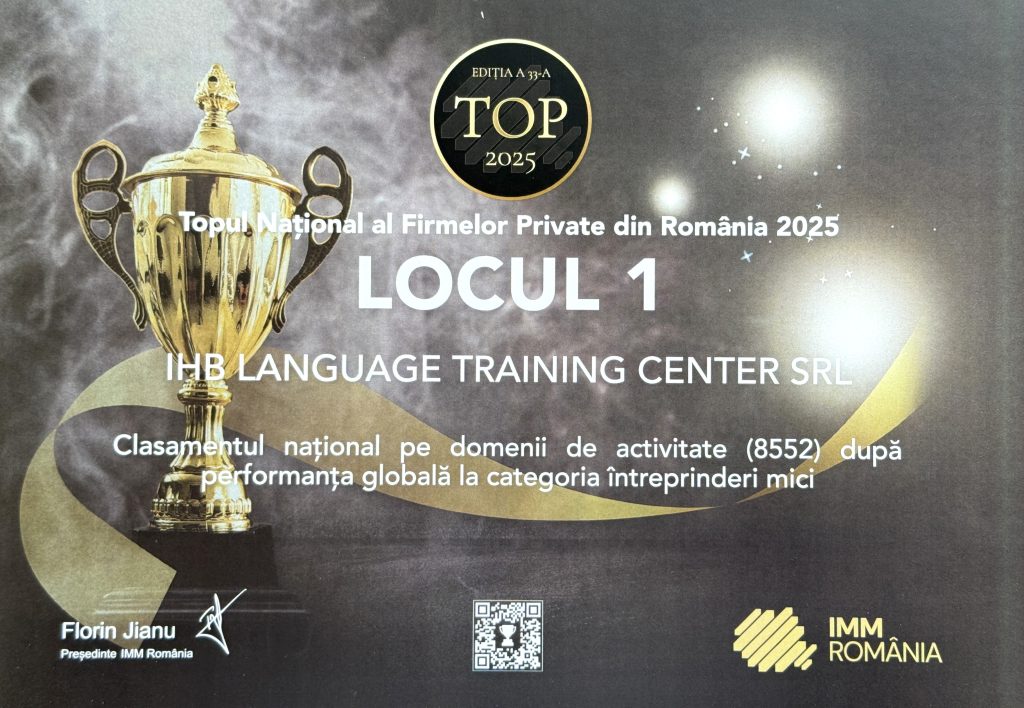
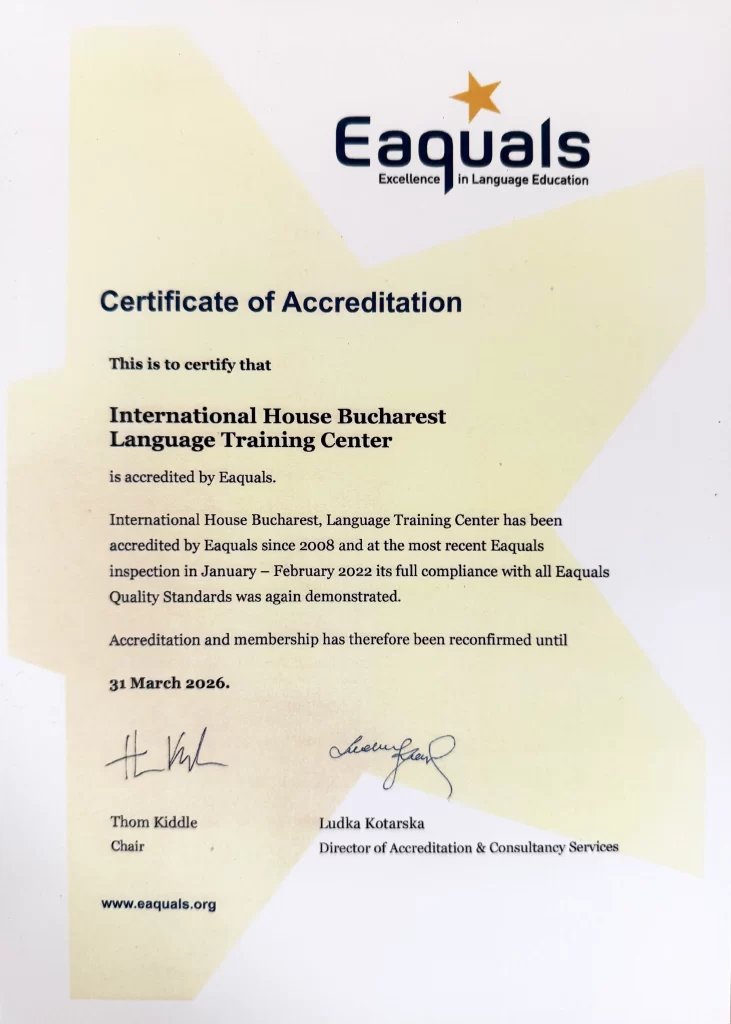
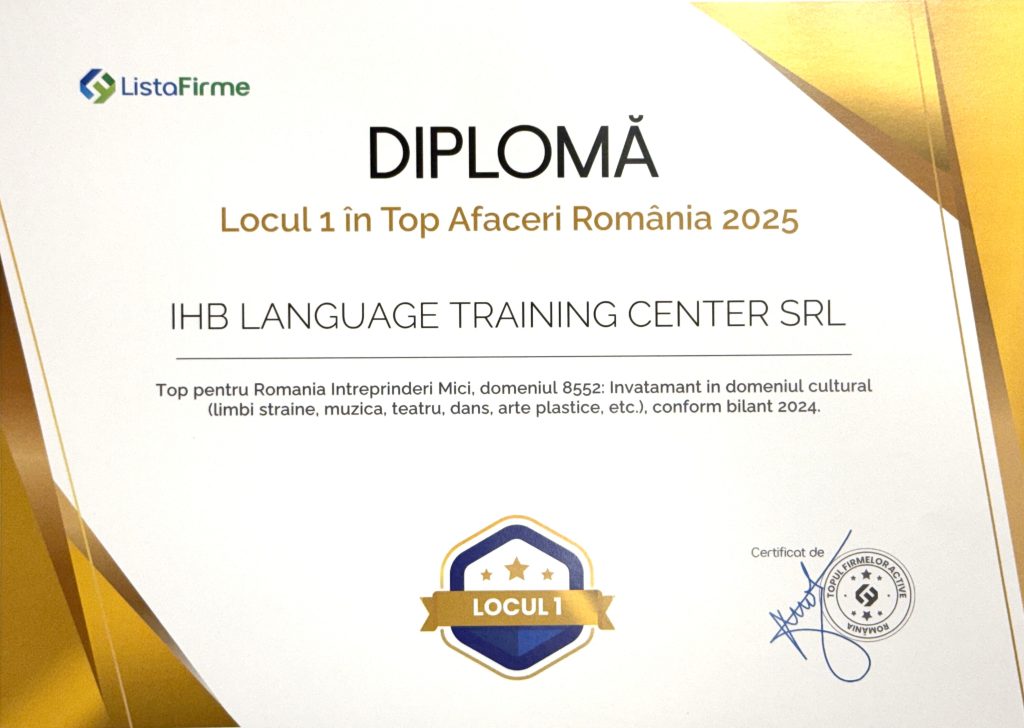
IH Bucharest has solid experience in corporate training, working with organizations from various fields. According to IH data, the center has worked with over 450 companies, over 48.000 adult learners and has a satisfaction rate of 96,5%, and in the Eaquals inspections in 2022 and 2026 it obtained 12/12 points of excellence, the only school in Romania with this score.
This experience is important for companies, as an LSR program should not be treated as an isolated course, but as part of a broader organizational communication strategy. IH can support companies with course structure, clear objectives, adaptation to the specifics of the team and, upon request, participation reports or progress assessments.
International House Bucharest offers Romanian Sign Language courses to companies, developed as an inclusive communication solution for the corporate environment. Through this initiative, IH Bucharest extends the idea of language training beyond traditional foreign languages and responds to a real need for accessibility, inclusion and organizational responsibility.
Photo: Unsplash
In the video below we briefly present the LSR courses for companies at International House Bucharest:
For which teams is a corporate LSR course suitable?
An LSR course can be useful for any organization, but the fastest impact occurs in teams that interact directly with people outside the company. For example:
HR and recruitment – for more accessible interviews, more inclusive onboarding, and a more open internal culture.
Customer service and front office – for basic interactions with deaf or hard of hearing people.
Retail, banking, telecom, healthcare, education – areas where access to clear information can directly influence the quality of service.
CSR / ESG / DEI teams – for concrete projects, with real social impact, not just communication initiatives.
Management and leadership – to better understand how to build an accessible organizational culture.
Why now?
Because accessibility is no longer a niche topic. It is a legislative, social and organizational direction. In Romania, Law 27/2020 recognizes LSR as a language in its own right, Law 448/2006 supports the rights of people with disabilities and access to work, and Law 232/2022 brings clear accessibility requirements for products and services in certain fields.
At the same time, people expect brands and employers to be more responsible, more empathetic, and better prepared to respond to the real diversity in society. An LSR course alone does not solve all accessibility challenges, but it is a concrete and visible step towards a more inclusive company.
Conclusion: LSR is more than a course. It is an investment in barrier-free communication.
For companies, LSR means more than learning some signs. It means openness, responsibility, respect, and the ability to build better relationships with people who are too often excluded from society's regular conversations.
Through Romanian Sign Language programs developed together with the CODA Foundation – The Charm of Silence , International House Bucharest helps organizations transform inclusion from intention into practice. For HR, L&D, customer service, CSR or management teams, LSR can become a valuable organizational competency: one that builds access, trust and real communication.
Through LSR courses dedicated to companies, International House Bucharest supports organizations to build more accessible, empathetic and responsible workspaces and professional interactions.
Frequent asked questions (FAQs)
What is LSR?
LSR stands for Romanian Sign Language. It is a visual-gestural language, with its own structure, lexicon and grammatical rules, used by the deaf community in Romania. Law no. 27/2020 officially recognizes LSR as a native language specific to deaf and/or hard of hearing people.
Why should companies learn LSR?
Companies can use LSR to improve accessibility, customer experience, employee inclusion, and CSR/ESG programs. For teams that work directly with the public, even basic skills can make a real difference.
Is LSR mandatory for companies?
It depends on the type of organization, the field of activity and the relationship with the public. There are legal provisions regarding accessibility, authorized interpreters, employment of people with disabilities and accessibility of certain products and services. For the exact interpretation of legal obligations, companies should consult a legal specialist.
Which departments would benefit most from an LSR course?
The most relevant departments are HR, recruitment, customer service, front office, retail, CSR, ESG, DEI, education, healthcare, banking, telecom and any team that interacts directly with clients, candidates or the general public.
Where can companies take LSR courses in Romania?
International House Bucharest offers LSR courses for companies, in collaboration with the CODA Foundation – Charmecul Tăcerii. The programs can be organized online, physically, in-company or in a modular format.
Before you sign up, we listen to your needs, test your language level, and only then do we recommend the best course for you.
Placement test
Quality guaranteed by global standards in foreign language teaching.
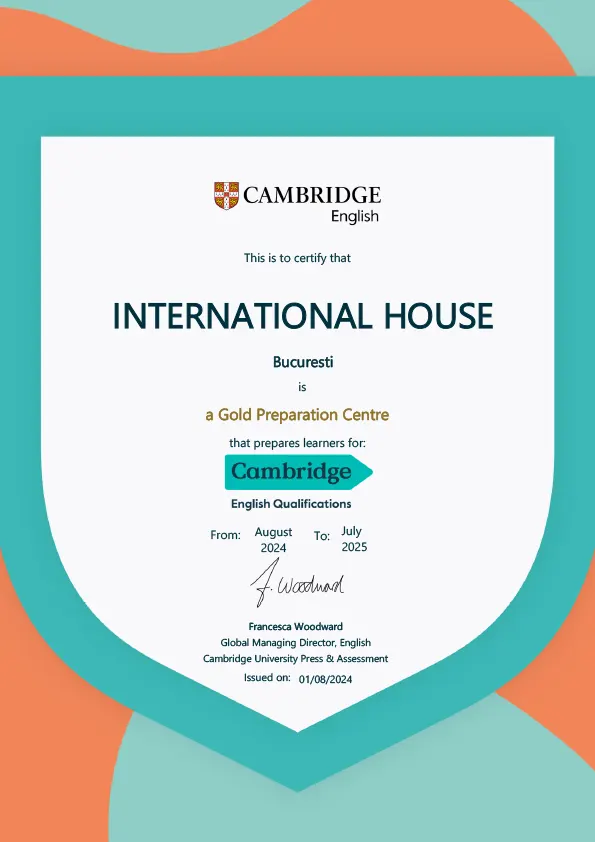
International House Bucharest is accredited by EAQUALS – Excellence in Language Education, part of the global network International House World Organisation and a Cambridge teacher training centre (CELTA & DELTA). We are ISO 9001 and ISO 27001 certified, ensuring quality, security and confidentiality in all our corporate programmes.
Manage consent
To provide the best experience, we use technologies such as cookies to store and/or access device information. Consent to these technologies allows us to process data such as browsing behavior or unique IDs on this site. If you do not give your consent or withdraw your given consent it may have negative effects on certain functionalities and functions.
function
Always active
Technical storage or access is strictly necessary for the legitimate purpose of enabling the use of a specific service explicitly requested by a subscriber or user or for the sole purpose of executing the transmission of a communication over an electronic communications network.
Preferences
Technical storage or access is necessary for the legitimate purpose of storing preferences that are not requested by the subscriber or user.
Statistics
Technical storage or access that is used exclusively for statistical purposes.Technical storage or access that is used exclusively for anonymous statistical purposes. Without a subpoena, voluntary compliance from your Internet Service Provider, or additional records from a third party, information stored or retrieved solely for this purpose cannot typically be used to identify you.
Marketing
Technical storage or access is necessary to create user profiles to which we send advertising or to track the user across one or more websites for similar marketing purposes.