UPDATE August 14, 2026: The transition period provided for by OUG 32/2026 has ended, and the platform WorkinRomania.gov.ro was officially launched on August 7, with functionalities implemented in stages. At the same time, it was published Official list of shortage occupations, which includes 289 occupations, as well as the technical rules for the operation of the platform. For employers, the obligations regarding the recruitment and integration of foreign workers must now be analyzed in relation to the new system, including the requirements regarding Romanian language courses and cultural and social integration, provided for a minimum of 6 months and a minimum of 6 hours per week. OUG 32/2026 is still in parliamentary procedure, so any subsequent amendments must be followed separately.
Updated on July 30, 2026
Hiring foreign workers in Romania is no longer just a recruitment process followed by obtaining documents. OUG No. 32/2026 introduces a new system, which tracks the entire journey of the foreign employee: recruitment, authorization, obtaining the right to work and stay, contracting, payroll, accommodation, linguistic integration and respect for his rights.
For HR departments, recruitment companies and Legal or Compliance teams, the change is important. Organizations must review their procedures, contracts, internal responsibilities and relationship with suppliers involved in the recruitment and integration of workers from outside the European Union.
OUG no. 32/2026 was published in the Official Gazette no. 335 of April 27, 2026 and entered into force on the same date. OUG 32/2026 obliges employers who employ foreign workers to comply with new rules regarding registration or authorization, bilingual contracts, payroll, OSH training, documentation of the employment relationship, and Romanian language and cultural integration courses.
This material is for informational purposes only and does not replace legal analysis applied to a company's particular situation.
In short:
OUG 32/2026 is in force since April 27, 2026; the WorkinRomania.gov.ro platform was officially launched on August 7, 2026.
Employers register or authorize themselves, and placement agencies need ANOFM authorization and financial guarantee.
The employment contract is concluded in two languages, the salary is paid into a bank account, and OSH training is provided in a language understood by the worker.
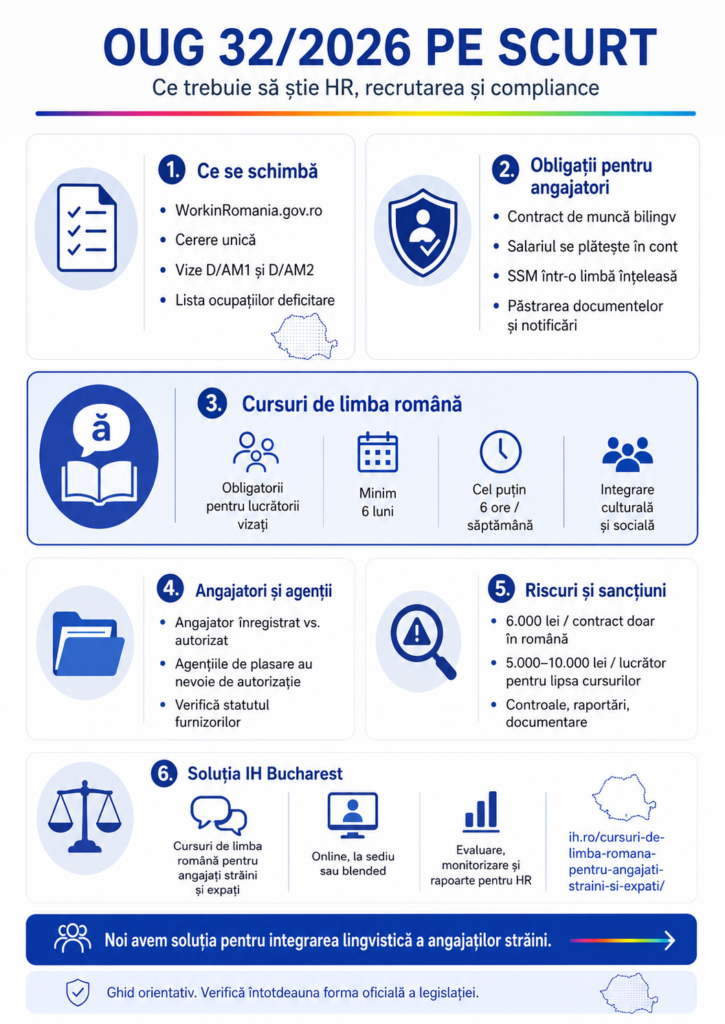
Romanian language courses with cultural and social integration last a minimum of 6 months, at least 6 hours per week; their absence is sanctioned with 5.000–10.000 lei for each worker.
At the end you will find three checklists: for HR, for recruitment companies, and for Legal and Compliance.
What changes? OUG 32/2026 for the employment of foreign workers?
The main changes concern:
registration and authorization of employers;
authorization of foreign worker placement agencies;
introduction of the WorkinRomania.gov.ro platform;
the emergence of a single application for the right to work and reside;
long-stay visas D/AM1 and D/AM2;
use of the List of Shortage Occupations;
bilingual individual employment contracts;
payment of salary into the employee's bank account;
accommodation, documentation and reporting obligations;
OHS training in a language understood by the worker;
Romanian language courses with elements of cultural and social integration.
PwC shows that the new system changes both the hiring procedure and the conditions under which employers and agencies can participate in the recruitment of foreign workers.
This OUG 32/2026 already in force?
Da OUG No. 32/2026 is in force since April 27, 2026.
However, the implementation of some mechanisms is phased. Therefore, HR and Legal must differentiate between:
the obligations already provided for by the ordinance;
transitional procedures;
the functionalities actually available in the WorkinRomania platform;
documents or lists to be officially approved.
The platform was officially launched on August 7, 2026, and the functionalities are being implemented in stages. During the previous testing period, the data entered did not produce legal effects, with the exceptions expressly provided by law.
What is WorkinRomania.gov.ro?
WorkinRomania.gov.ro is the electronic platform through which the authorities aim to centralize the procedures regarding the access of foreign workers to the Romanian labor market.
The platform is intended for:
employers;
authorized employers;
authorized placement agencies;
foreign workers;
institutions that verify and monitor procedures.
Through WorkinRomania, employers will be able to create accounts, upload firm job offers, submit single applications and track the status of applications. Agencies will be able to request authorization, report placement activity and manage applications for intermediated workers.
What companies need to know during the transition period
Applications and appointments made under the previous system may be subject to transitional provisions.
OUG 32/2026 provides, among other things, that applications for employment or secondment permits submitted before its entry into force shall be resolved according to the rules applicable on the date of submission. Also, the date of August 7 2026 is relevant for some transitional procedures, and from August 8 2026 New rules apply for certain changes of employer.
Companies should not assume that the new platform has already fully replaced all previous procedures. Each case must be verified based on the appointment date, the filing date, and the worker's situation.
Registered employer or authorized employer?
OUG 32/2026 differentiates between employers who must register and those who must obtain an authorization.
Registered employer
Registration is relevant, among others, for employers who want to hire:
workers covered by the D/AM1 visa, including highly skilled workers;
certain categories of D/AM2 workers recruited through an authorized placement agency.
Authorized employer
Authorization is required for employers who wish to directly recruit certain categories of permanent, seasonal or cross-border workers, without using the services of an authorized placement agency.
Among the conditions presented by OUG 32/2026 are found:
effective and uninterrupted economic activity for at least 24 months;
at least 50 employees, as an average number in the previous year;
lack of outstanding obligations to the general consolidated budget;
fulfillment of the conditions relating to the tax record;
establishing a financial guarantee of 1.000 euros for each foreign worker;
compliance with certain indicators relating to cancelled or revoked visas.
For companies that do not meet these conditions or that do not want to manage the entire process internally, collaborating with an authorized placement agency may become the relevant operational option.
What is changing for recruitment and placement agencies?
OUG 32/2026 expressly regulates the activity of agencies that place foreign workers on the Romanian labor market.
The agencies concerned must obtain an authorization issued by the National Employment Agency. The authorization is valid for two years and can be extended for successive periods of two years.
Agencies must provide a financial guarantee of:
75.000 euros for up to 250 placed foreign workers;
another 50.000 euros for each additional up to 250 workers.
The placement activity is related to the occupations included in the List of Shortage Occupations and to firm job offers submitted by registered employers.
What to check before hiring an agency
HR, Procurement and Legal should include in the due diligence process:
the existence and validity of the agency's authorization;
the responsibilities of each party;
how workers' documents are managed;
costs and fees charged;
obligations regarding transport and accommodation;
informing the worker before arriving in Romania;
responsibility for document translation;
the procedure applicable if the employment relationship ends;
obligations regarding linguistic and cultural integration;
personal data protection.
The mere existence of a commercial contract with an agency does not eliminate the employer's responsibilities towards the worker.
What are D/AM1 and D/AM2 visas?
OUG 32/2026 introduces a differentiation between long-stay visas for employment.
D/AM1 visa
The D/AM1 visa applies to highly skilled workers and other special categories provided for by law.
D/AM2 visa
The D/AM2 visa is intended for permanent, seasonal, and cross-border workers employed in occupations included in the Shortage Occupations List.
Depending on the category, the application can be submitted by:
the registered employer;
the authorized employer;
authorized placement agency.
The new system uses a single application , completed and submitted electronically along with the required documentation.
What is the Shortage Occupations List?
The list of shortage occupations establishes occupations for which there is a labor shortage and which may enter certain procedures associated with the D/AM2 visa.
The official list, with 289 occupations, was published in August 2026. Until then, the dedicated section on WorkinRomania only displayed demonstrative data, which did not represent the list approved by order of the minister.
The official list must be approved by order, published in the Official Gazette and updated semi-annually or whenever necessary.
Therefore, before a recruitment project, the company checks the occupation in the current form of the official list.
The foreign employee's employment contract must be bilingual
The individual employment contract must be concluded:
in Romanian; and
in the language of the employee's home state or in an internationally spoken language that the employee understands or can reasonably be assumed to understand.
For Legal and HR, this obligation means more than the mechanical translation of a standard model.
The company must aim to:
the concordance between the two versions;
using correct terminology;
clear presentation of salary, schedule, place of work and responsibilities;
documenting that the employee has received and understood the contract;
updating of additional acts in both languages.
Concluding an individual employment contract only in Romanian may be sanctioned with a fine of 6.000 lei for each contract.
The salary must be paid into a bank account
The employer must make the payment of the remuneration or salary into the foreign worker's bank account.
This rule contributes to:
payment traceability;
reducing the risk of abuse;
verification of compliance with salary conditions;
the existence of clear evidence in the event of an inspection.
HR and Payroll departments must ensure that account opening and bank details are included in the onboarding process.
OHS training must be conducted in a language understood by the worker
The employer must provide occupational health and safety training in a language that the foreign employee understands.
A signed form is not sufficient if the worker did not actually understand:
workplace risks;
rules for using equipment;
emergency procedures;
signaling;
how to report an incident;
his responsibilities.
The obligation is particularly important in construction, manufacturing, logistics, agriculture, transportation and other fields where linguistic misunderstandings can cause accidents or operational errors.
Romanian language courses become an obligation for employers
One of the most important changes for HR is the obligation to provide Romanian language courses for foreign workers.
right OUG 32/2026, employers must ensure, directly or through accredited providers or in collaboration with the institutions and organizations provided for by law:
Romanian language courses;
elements of cultural and social integration;
for a period of at least six months from the start of the activity registered in REGES-ONLINE;
lasting at least six hours per week. Six hours per week, for approximately 26 weeks, means an approximate volume of approximately 156 hours for each participant.
The text of the ordinance allows for the organization of:
directly by the employer;
through accredited suppliers;
in collaboration with public institutions;
through non-governmental organizations;
through international organizations;
through educational institutions.
The company must verify with the legal department the status of the supplier, the structure of the program, and the documents necessary to demonstrate compliance with the obligation.
Is a self-study app enough?
OUG 32/2026 specifies the duration and general components, but does not exhaustively detail all the pedagogical methods that can be used.
From a compliance perspective, it is recommended that the program include:
initial assessment;
nominal registration of participants;
a calendar of at least six months;
activity records;
Romanian language materials;
cultural and social integration content;
monitoring progress;
reports or evidence of participation;
certificates or endorsements;
a procedure for absences and recoveries.
Technical access to a platform, without monitoring and without evidence of the participant's activity, may be more difficult to sustain in the event of an audit.
What fine does the employer risk if he does not provide the courses?
Violation of the obligations under art. 7 para. (1) letter g), relating to Romanian language courses and cultural and social integration, is sanctioned with a fine of 5.000 to 10.000 lei for each foreign worker concerned.
It is important to separate this sanction from other fines provided for by OUG 32/2026. For other violations, including certain unauthorized recruitment or placement activities, sanctions can reach 40.000 lei and can be applied for each worker.
What other obligations does the employer have?
OUG 32/2026 also introduces obligations regarding:
notification of unexcused absences exceeding three consecutive working days;
notification of termination of the individual employment contract;
reporting exploitation or danger situations;
submission of documents to control authorities;
keeping copies of travel or residence documents;
workers' access to confidential grievance procedures;
keeping supporting documents for a minimum of five years after the termination of the employment relationship;
accommodation conditions.
If the employer provides accommodation, the rent cost borne by the worker cannot exceed 25% of his or her net remuneration or salary.
OUG 32/2026 introduces new responsibilities for employers, recruitment agencies and compliance teams managing foreign workers in Romania.
HR checklist
The HR department should start with a clear inventory:
What foreign employees are already in the company?
What is the legal basis for residence and the right to work?
When did each person start working in REGES-ONLINE?
Are contracts available in two languages?
Is the salary paid into a bank account?
Was the OHS training conducted in an understandable language?
Is there a Romanian language and cultural integration program?
Can the company demonstrate participation and progress?
Are the necessary documents for control kept?
Are there procedures for reporting absences and incidents?
Checklist for recruitment companies
Recruitment companies must verify:
if their activity falls within the category of regulated placement OUG 32 / 2026;
whether they need authorization;
what financial guarantee must be provided;
what occupations they can recruit for;
what information must be provided to the worker;
what commissions are allowed;
who bears the costs of transportation and documentation;
how personal data is protected;
what obligations exist after the termination of the contract;
how the relationship with the employer is documented.
Checklist for Legal and Compliance
Legal teams should aim to:
updated form of OUG 32 / 2026;
instructions issued by IGI, ANOFM and the Ministry of Labor;
new functionalities in WorkinRomania.gov.ro, implemented in stages;
updates to the List of Shortage Occupations, revised biannually or whenever necessary;
approved contract models;
concordance of bilingual documents;
the status of placement agencies;
eligibility of training providers;
reporting and document retention;
the sanctions applicable to each obligation.
How International House Bucharest can help
For companies that need to organize Romanian language courses for foreign employees , International House Bucharest has a solution that can be configured according to the number of participants, work schedule, company industry and reporting requirements.
International House Bucharest is:
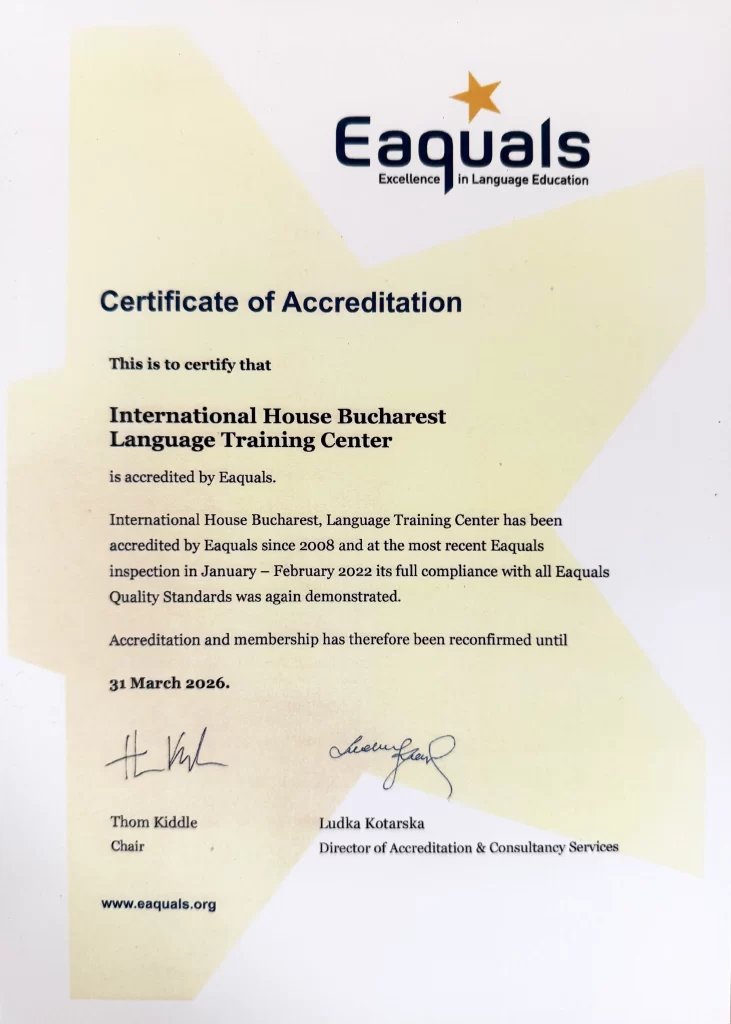
EAQUALS accredited language training provider;
Cambridge authorized center for teacher training;
part of the global International House network;
ISO 9001 and ISO 27001 certified organization;
center of excellence in all 12 areas assessed in EAQUALS inspections;
partner with experience in corporate and Romanian language training for expats and foreign employees.
IH's role is that of a strategic partner for companies, with personalized programs and measurable results, not just a one-time course provider.
What can the IH program include?
Depending on the chosen configuration, the solution may include:
communication for administrative and everyday situations;
cultural and social integration;
activity monitoring;
reporting to HR;
periodic evaluations;
participation certificates;
programs of at least six months;
a study volume configured according to the company's requirements.
The IH platform allows for programs of up to approximately 160 hours, and trainer sessions can be added depending on the level of support and interaction required.
The program should be configured with the company team so that the duration, frequency, content and documentation support the applicable requirements. Final legal validation of compliance rests with the company and its legal counsel.
Do you have foreign employees or are you preparing an international recruitment project?
There is no need to build the curriculum, platform, monitoring, and reporting system from scratch.
The program can be adapted for small teams or large-scale implementations, online or with a teacher, with flexible structure and useful documents for HR.
Request a personalized evaluation and quote for your company.
Frequent asked questions (FAQs)
OUG 32/2026 is in force?
Yes. The ordinance entered into force on April 27, 2026. However, some procedures and functionalities are being implemented in stages.
Is the WorkinRomania.gov.ro platform functional?
Yes. The platform was officially launched on August 7, 2026, and some functionalities are being implemented in stages.
Are Romanian language courses mandatory?
Yes, for situations falling under art. 7 of OUG 32/2026. The courses must include cultural and social integration, last a minimum of six months and have at least six hours per week.
What fine is applied for not organizing courses?
The fine is between 5.000 and 10.000 lei for each foreign worker targeted.
Can the employment contract be only in Romanian?
No. The contract must also be written in a language understood by the employee. A contract concluded only in Romanian may attract a fine of 6.000 lei for each contract.
Can the course be organized through an external provider?
Da OUG 32/2026 allows for direct organization by the employer or through accredited providers and other categories of institutions and organizations provided for by law.
Conclusion: integration is no longer optional, but strategic
OUG 32/2026 marks an important change for companies employing foreign nationals in Romania. Linguistic and cultural integration becomes a concrete responsibility, with a direct impact on compliance, internal communication, retention and operational performance.
International House Bucharest can support companies through Romanian language courses for foreigners, cultural integration programs and corporate solutions adapted to the work environment.
Do you have foreign employees in the company? Sign them up for Romanian for Work or request a personalized program for your team.
Quality guaranteed by global standards in foreign language teaching.
International House Bucharest is accredited by EAQUALS – Excellence in Language Education, part of the global network International House World Organisation and a Cambridge teacher training centre (CELTA & DELTA). We are ISO 9001 and ISO 27001 certified, ensuring quality, security and confidentiality in all our corporate programmes.
Manage consent
To provide the best experience, we use technologies such as cookies to store and/or access device information. Consent to these technologies allows us to process data such as browsing behavior or unique IDs on this site. If you do not give your consent or withdraw your given consent it may have negative effects on certain functionalities and functions.
function
Always active
Technical storage or access is strictly necessary for the legitimate purpose of enabling the use of a specific service explicitly requested by a subscriber or user or for the sole purpose of executing the transmission of a communication over an electronic communications network.
Preferences
Technical storage or access is necessary for the legitimate purpose of storing preferences that are not requested by the subscriber or user.
Statistics
Technical storage or access that is used exclusively for statistical purposes.Technical storage or access that is used exclusively for anonymous statistical purposes. Without a subpoena, voluntary compliance from your Internet Service Provider, or additional records from a third party, information stored or retrieved solely for this purpose cannot typically be used to identify you.
Marketing
Technical storage or access is necessary to create user profiles to which we send advertising or to track the user across one or more websites for similar marketing purposes.