Somehow, foul language and swear words are the first to "stick" to us when we are exposed to a foreign language. We may not speak much French, but we can easily exclaim "m**de!". Or, without knowing a word of German, we are well acquainted with the slur that "s****ße!" expresses. And in English, obviously, even without having an advanced level, many of us easily roll the so-called four-letter words - "s**t", "f**k", you know...
Although we don't teach these kinds of words in English class , as they are not included in textbooks because they are considered "ugly" or insulting, and it is assumed that it is not appropriate to learn and use them, movies, pop music and even natural contemporary English abound with such vocabulary. It is certainly part of everyday language and, in a sense, it is even necessary to express our frustration, disapproval, pain, anger and other such emotions. So... why wouldn't we learn it? Not out of prudishness, let's hope.
Photo: Unsplash
What is English slang?
Slang is an important component of any language and is worth knowing. If not to use it ourselves, then at least to recognize when someone is talking badly to us, insulting us or... simply trying to be friendly with us, talking to us as equals. Because in English slang does not only include "bad words", but also colloquial terms from spoken language, the kind of words or non-standard formulations that are usually used in a completely informal conversation between friends.
15 common English slang expressions
There is an abundance of slang in English, with many social classes and age groups having their own slang, from schoolchildren to prisoners. There is also slang typical of American English and slang typical of British or Australian English. However, if we were to focus on the most commonly used slang elements in informal "universal" English , these would include those in the table below.
Phrase
What does it mean
Example
gonna
informal contracted form for going to
I'm gonna let them know where Cory is. / I'll let them know where Cory is.
bath
informal contracted form for want to
I don't want to go there. / I don't want to go there.
gotta
informal contracted form for (have) got to
I have to go now. / I have to leave now.
innit
informal (British) contracted form for isn't it
That Porsche is totally cool, right? / That Porsche is super cool, isn't it?
ain't
non-standard form for am not, is not, aren’t, haven't
You're not my boss! / You are not my boss!
babe
attractive person (and affectionate nickname)
Your friend Tara is such a babe! / How cool is your friend, Tara!
mate
friend (British)
Thanks a lot, mate! / Thank you very much, brother!
Cheers!
thank you! (British, informal)
I can certainly use that, cheers! / It's definitely useful, thanks!
Wicked!
great! (British)
So we're all going! Wicked! / So let's all go! Great!
My bad!
my mistake! (American)
I forgot to call you. My bad! / I forgot to call you. Sorry!
dope / sweet
great, "cool" (American)
Yo, that new iPhone is dope! / Listen, that new iPhone is a bargain!
to have a blast / a ball
to have a great time
Last night's party was amazing! I had a blast! / I had the most fun last night!
to spill the beans
to reveal a secret
Hey, Sue's pregnant! Tom's spilled the beans! / Sue is pregnant! Tom has left the house!
to be skinned
to be left-handed (British)
I can't go out because I'm skinny. / I can't go out, I'm a lefty.
I'm off
to leave, to take it away
I'm off to do the shopping. / I'm going shopping.
Golden rule: slang, only in an informal context
All these terms, and many others like them, give naturalness to our English and bring us closer to native speakers. However, it is very, very important to follow this golden rule: to always use them in the right context, that is, informally : with friends or relatives, never with superiors or, God forbid, at a job interview!
Slang between friends, neutral register at the office
At work, the same ideas have neutral variants, which are good to have on hand:
Between friends
At the office
I'm going to send it.
I'm going to send it.
Cheers!
Thank You.
My bad!
Sorry, my mistake.
I'm skinny.
It's not in my budget right now.
I have to go.
I have to leave now.
The difference between registers is most easily practiced in conversation, with feedback. In the English courses for adults at International House Bucharest, you can ask for an emphasis on conversation during the individual course, and teams working with foreign clients can take English courses for companies.
Quality guaranteed by global standards in foreign language teaching.
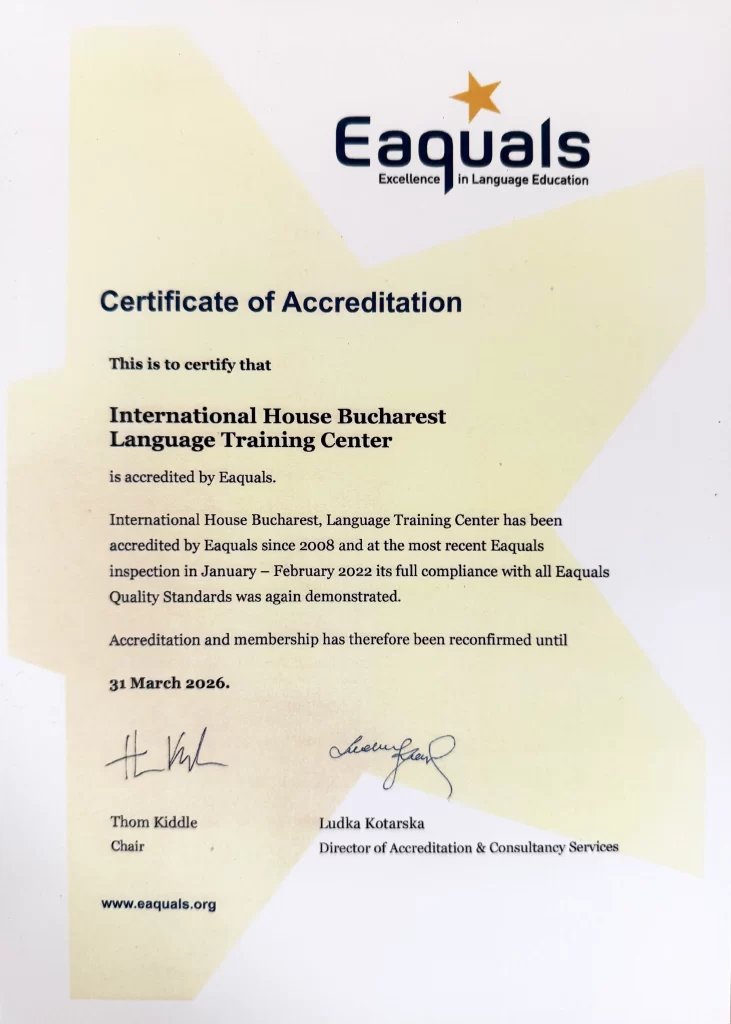
International House Bucharest is accredited by EAQUALS – Excellence in Language Education, part of the global network International House World Organisation and a Cambridge teacher training centre (CELTA & DELTA). We are ISO 9001 and ISO 27001 certified, ensuring quality, security and confidentiality in all our corporate programmes.
Manage consent
To provide the best experience, we use technologies such as cookies to store and/or access device information. Consent to these technologies allows us to process data such as browsing behavior or unique IDs on this site. If you do not give your consent or withdraw your given consent it may have negative effects on certain functionalities and functions.
function
Always active
Technical storage or access is strictly necessary for the legitimate purpose of enabling the use of a specific service explicitly requested by a subscriber or user or for the sole purpose of executing the transmission of a communication over an electronic communications network.
Preferences
Technical storage or access is necessary for the legitimate purpose of storing preferences that are not requested by the subscriber or user.
Statistics
Technical storage or access that is used exclusively for statistical purposes.Technical storage or access that is used exclusively for anonymous statistical purposes. Without a subpoena, voluntary compliance from your Internet Service Provider, or additional records from a third party, information stored or retrieved solely for this purpose cannot typically be used to identify you.
Marketing
Technical storage or access is necessary to create user profiles to which we send advertising or to track the user across one or more websites for similar marketing purposes.