
November 26 2026

In an increasingly interconnected job market populated by companies whose working language is English, the use of this language has become one of the basic skills that any job candidate is expected to have. In short, it is essential for any professional to know English, even if not necessarily at an advanced level.
Content
But what kind of English should we start learning? As a rule, good language centers offer two options: general English and business English . The former is chosen by students who need English more for personal purposes (vacations, friends, etc.), while business English is chosen by those interested in using this language in a professional context (business trips, business meetings, etc.).
The main difference between the two concerns the topics and vocabulary covered: a general English course includes lessons on holidays, media, celebrities, family, etc., while a business English course addresses business-related topics, focusing on vocabulary specific to a number of professional contexts, as we will see shortly. In addition, a business English course usually also includes professional skills sections, in which expressions typically used in certain work situations (work meetings, symposiums, etc.) are studied.
| General English | Business English | |
|---|---|---|
| For whom | learners who use English for personal purposes | employees and professionals who use English at work |
| TOPICS | holidays, family, media, free time | brands, advertising, money, human resources, international markets, leadership |
| Practiced situations | everyday conversations, travel | meetings, presentations, negotiations, work calls and emails |
| result | fluent communication in everyday life | language and professional skills practiced together |
Therefore, the biggest benefit of learning business English is that we get to use this language like a professional who belongs to the business world and has a solid business culture. In a way, mastering business English is equivalent to having an international business passport: as a Romanian employee, we speak “the same language” as a professional from a multinational in Singapore, Brazil or Senegal. Business English is, in effect, the language of globalism – whether we use it to communicate with a business partner in Bulgaria, or use it in a video conference with colleagues from all over the world.
Much of this “same language” consists of company “jargon”: vocabulary and linguistic “formulas” or standard expressions specific to work situations. These can be related to a wide range of business topics, the most common of which, judging by specialized textbooks, are the following: brands, business travel, types of organization, advertising, money, human resources, international markets, ethics, leadership, competition.
Typical work situations where we need standard wording and expressions to be effective include, among others:
Last but not least, by learning English for business we can improve, in parallel with acquiring linguistic knowledge, our strictly professional skills related to the studied work situations. In other words, by studying the standard expressions used in meetings held in English, we simultaneously improve our ability to participate effectively in a work meeting. Therefore, a business English course always involves a double benefit: professional and linguistic. By following such a course, we become both better English users and better professionals.
For teams, International House Bucharest organizes English courses for companies , face-to-face or online, built on the real work situations of employees: meetings, presentations, negotiations, emails. To know where the team is starting from, we first recommend a language audit , which shows the level of each employee and what they have to work on.
If you want to learn on your own, you can also find foreign language courses for adults, individual or blended, in Bucharest and online. You can write to us at receptie@ih.ro.
Source: British Council Romania



Quality guaranteed by global standards in foreign language teaching.



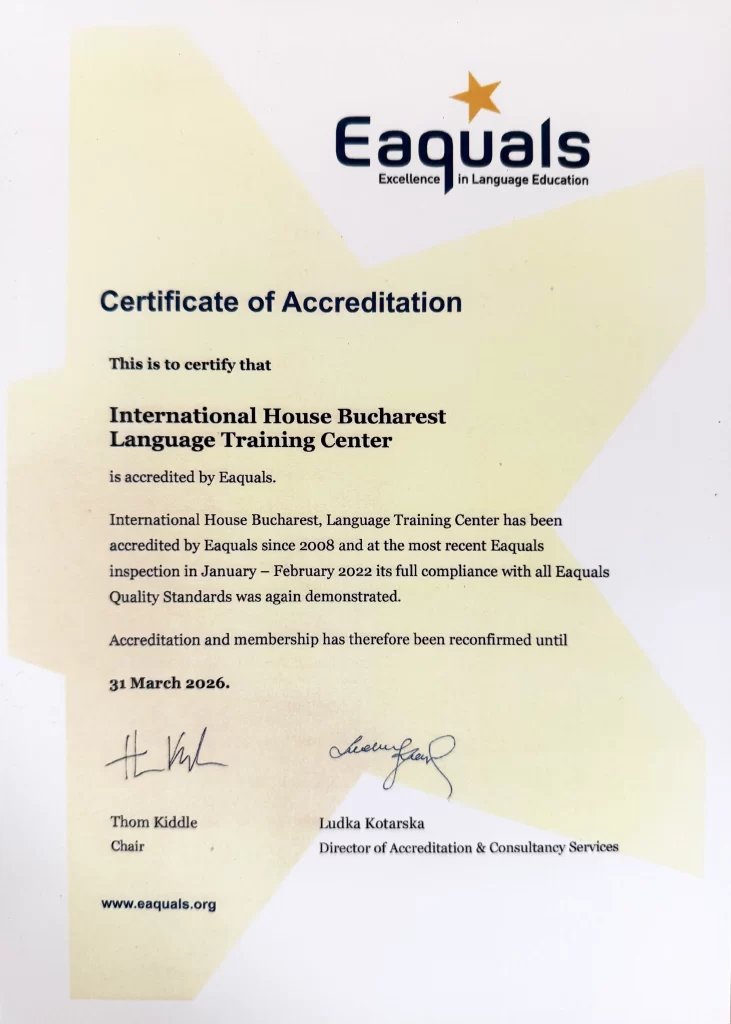
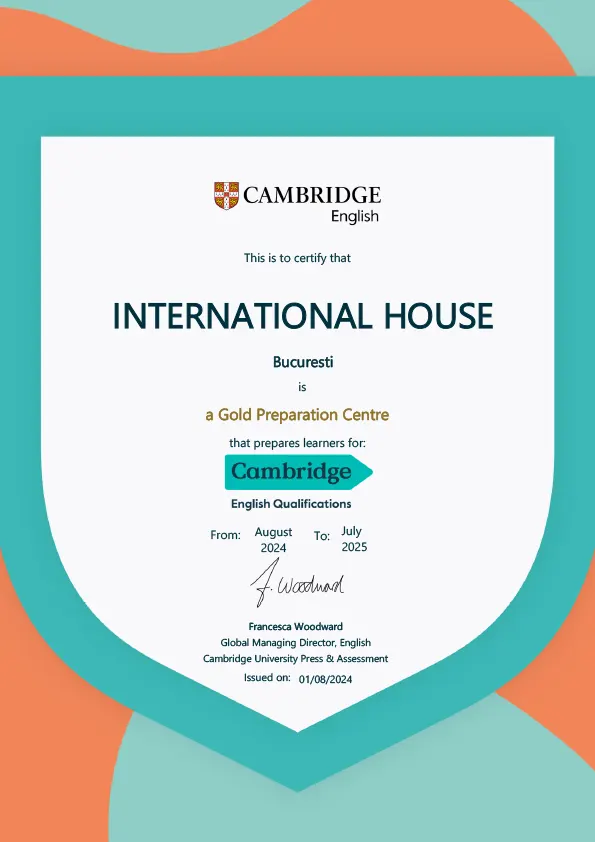
International House Bucharest is accredited by EAQUALS – Excellence in Language Education, part of the global network International House World Organisation and a Cambridge teacher training centre (CELTA & DELTA). We are ISO 9001 and ISO 27001 certified, ensuring quality, security and confidentiality in all our corporate programmes.